


When you apply your favorite perfume, you probably don't think about what exactly is in that small bottle. Yet, the world of perfume ingredients is incredibly complex and diverse. From natural essential oils to synthetic molecules, fixatives, and solvents – a fragrance consists of much more than just a pleasant scent. In an era where we are increasingly focusing on conscious consumption, it's worth taking a closer look at the composition of our perfumes. This article will help you uncover the secrets behind ingredient lists and make informed decisions when buying perfume.
The Basis of Every Perfume: Alcohol and Water
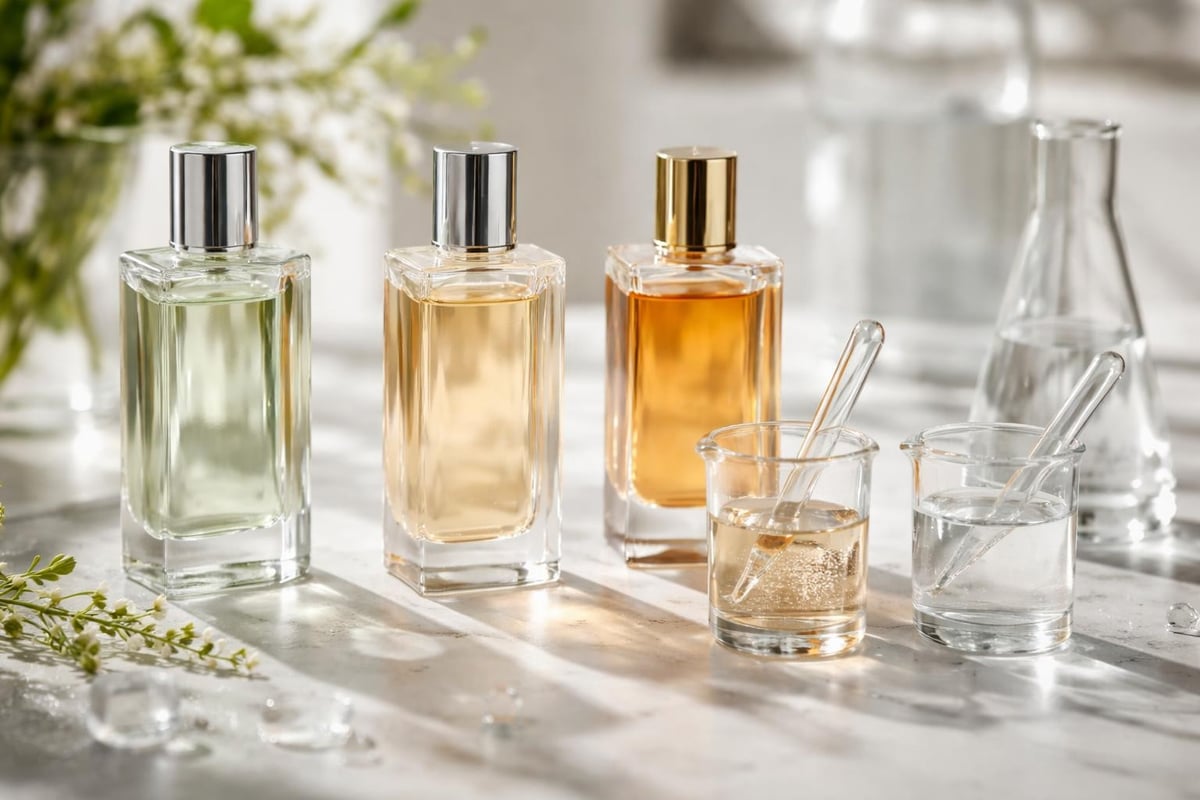
The majority of a perfume actually consists not of fragrances, but of alcohol and water. These two components form the foundation upon which the actual fragrance composition is built.
Alcohol fulfills several important functions:
- It dissolves the fragrance molecules and keeps them in suspension.
- It allows for even distribution of the perfume on the skin.
- It evaporates quickly, releasing the fragrance compounds.
- It acts as a preservative and extends shelf life.
Typically, ethanol (grain alcohol) is used, usually in a concentration between 70 and 90 percent. For vegan products, it is important to know that the alcohol used has not been produced from animal products.
Water Content in Different Perfume Types
Water is added to dilute the concentration and regulate the intensity. The ratio of fragrance oil, alcohol, and water varies considerably depending on the perfume type.
| Perfume Type | Fragrance Oil Concentration | Alcohol/Water |
|---|---|---|
| Eau de Cologne | 3-5% | 95-97% |
| Eau de Toilette | 5-15% | 85-95% |
| Eau de Parfum | 15-20% | 80-85% |
| Perfume (Extrait) | 20-40% | 60-80% |
The composition of perfumes and scented waters determines not only the intensity but also the longevity of the scent on your skin.
The Real Stars: Fragrances and Their Origin
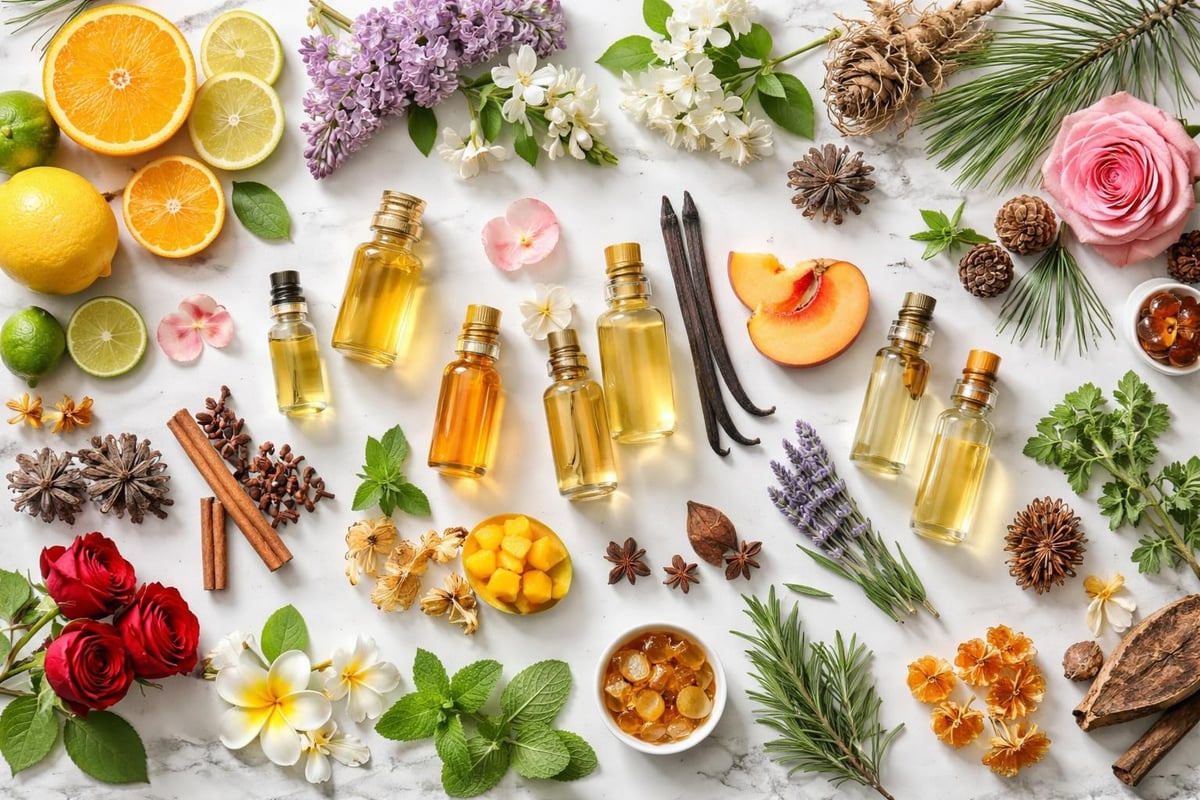
The perfume ingredients that create the characteristic scent usually make up only 10 to 30 percent of the total composition. These fragrances can generally be divided into three categories.
Natural Fragrances
Natural fragrances are extracted from plants, flowers, fruits, woods, or resins. Extraction is carried out using various methods:
- Distillation – essential oils are extracted using steam
- Expression – mechanical pressing, typical for citrus fruits
- Solvent extraction – for delicate flowers like jasmine or rose
- Enfleurage – traditional method using fats (rare today)
Natural fragrances have a special charm but are also more expensive and limited in availability. Furthermore, they can trigger allergies – natural does not automatically mean more compatible.
Synthetic Fragrances
Synthetic fragrances are created in the laboratory and today make up the majority of modern perfume compositions. They offer several advantages:
- Consistent quality and availability
- Creation of fragrance notes that do not exist in nature
- Often more cost-effective than natural alternatives
- Controllable purity without impurities
Important to know: Synthetic does not automatically mean harmful. Many synthetic fragrances are safer and more skin-friendly than their natural counterparts. For vegan unisex perfumes, special care is taken to ensure that neither animal ingredients nor animal testing are used.
Semi-Synthetic Fragrances
This category bridges the gap between nature and the laboratory. Semi-synthetic fragrances start with a natural raw material that is then chemically modified. A classic example is vanillin, which is extracted from natural vanilla and then synthetically altered.
The various fragrance groups in perfumes each fulfill specific functions in the overall composition.
The Fragrance Pyramid: Top, Heart, and Base Notes
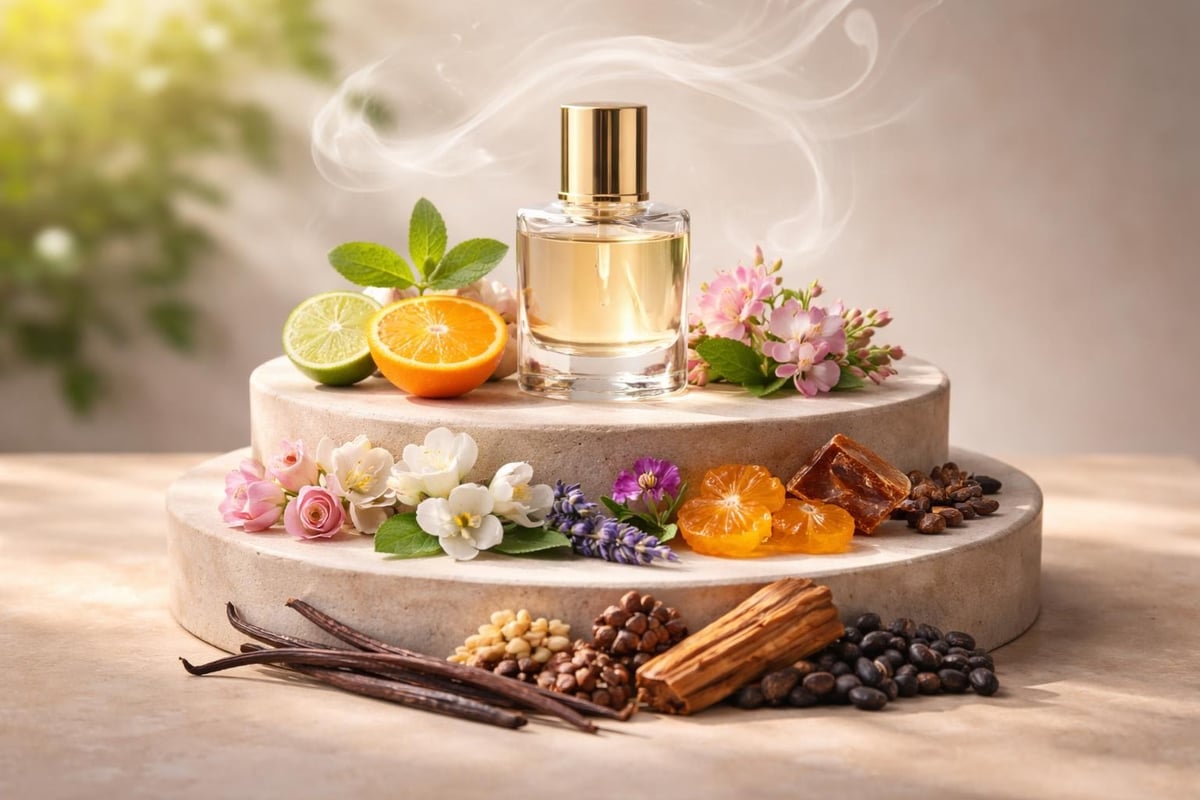
A high-quality perfume is structured like a musical composition. The perfume ingredients are strategically arranged in three layers that are perceived sequentially over time.
Top notes create the first impression:
- Light, volatile molecules
- Scent lasts for about 15-30 minutes
- Typical representatives: citrus, herbs, fresh green notes
- Attract attention and spark interest
The heart notes develop after about 30 minutes and form the core of the fragrance. They last for several hours and define the true character of the perfume. Floral notes like rose, jasmine, lavender, or spicy nuances dominate here.
Finally, the base notes emerge – heavy, long-lasting molecules that give the fragrance depth and persistence. These can remain on the skin for 4 to 8 hours or even longer.
| Fragrance Level | Duration | Typical Ingredients |
|---|---|---|
| Top Note | 15-30 Min | Bergamot, Lemon, Mint |
| Heart Note | 2-4 Hrs | Rose, Jasmine, Clove, Lavender |
| Base Note | 4-8+ Hrs | Sandalwood, Musk, Vanilla, Amber |
Fixatives: The Invisible Helpers
Fixatives are among the most important, yet least known perfume ingredients. Their task is to bind the volatile fragrance compounds and make the perfume last longer.
Natural Fixatives
Traditionally, animal substances were used as fixatives:
- Musk from the musk deer
- Ambergris from the digestive tract of sperm whales
- Civet from the glands of the civet cat
- Castoreum from the glands of beavers
These ingredients have largely disappeared today for ethical reasons – thankfully! Modern vegan perfumes rely on plant-based fixatives such as labdanum, benzoin resin, tonka bean, or oakmoss.
Synthetic Fixatives
The perfume industry has developed synthetic alternatives that can perfectly replace animal fixatives. Synthetic musk, for example, is now standard in the industry. For clean beauty products, care is taken to ensure that only safe, well-researched synthetic fixatives are used.
Other technical aids include thickeners and emulsifiers, which are particularly important in perfume creams and oils. The main components of perfumes work together to create a harmonious overall experience.
Allergens and Declarable Substances
In the EU, there are clear regulations on which perfume ingredients must be separately declared. 26 fragrance substances are considered potential allergens and must be listed on the packaging above a certain concentration.
The most common declarable fragrance substances:
- Linalool (in lavender, coriander)
- Limonene (in citrus fruits)
- Geraniol (in roses, geraniums)
- Citronellol (in roses, geraniums)
- Citral (in citrus fruits, lemongrass)
- Eugenol (in cloves, cinnamon)
- Coumarin (in tonka bean, sweet woodruff)
- Cinnamal (in cinnamon)
This does not mean that these substances are dangerous. Most people tolerate them without problems. However, the declaration requirement helps people with known allergies make informed decisions.
Reading the Ingredient List Correctly
If you look at the ingredient list of a perfume, you will often only find the word "Parfum" or "Fragrance". This is the collective term for the fragrance composition, which is protected as a trade secret. This is followed by the individually listed allergenic fragrance substances.
For clean beauty products, you often receive more detailed information about the ingredients used – a sign of transparency and quality awareness.
Controversial Ingredients: What to Avoid
Not all perfume ingredients are harmless. Some substances are criticized and increasingly avoided by conscious consumers.
Phthalates
Phthalates are used as plasticizers and solvents. They are suspected of being hormonally active and impairing fertility. In the EU, some phthalates are already banned, while others are still used. Clean beauty brands consistently avoid this group of substances.
Synthetic Musk Compounds
While modern synthetic musk compounds are generally safer than earlier generations, some accumulate in the body. Nitro-musk and polycyclic musk compounds are particularly critical.
Problematic Natural Ingredients
Even natural substances can be concerning. Oakmoss, for example, is a popular natural fragrance but has a high allergenic potential. Some essential oils can sensitize the skin at high concentrations or are not recommended during pregnancy.
Knowing the secret ingredients in perfumes allows you to make more conscious purchasing decisions.
Clean Beauty and Vegan Perfumes: The New Standard
The movement towards transparent, ethically sound products has also reached the perfume industry. Clean beauty perfumes are characterized by certain quality features:
- Avoidance of questionable ingredients – no phthalates, parabens, or critical synthetic musk compounds
- Vegan formulations – no animal ingredients like animal musk or ambergris
- Cruelty-free – neither the final product nor ingredients tested on animals
- Transparency – open communication about raw materials used
- Sustainable production – environmentally friendly manufacturing and packaging
When choosing a vegan perfume, you automatically ensure that no animal perfume ingredients are used. This also includes subtle components that are often overlooked.
German Quality and Local Production
Perfumes produced in Germany are subject to strict quality controls and EU regulations. Local production also means shorter transport routes and thus a better environmental balance. Brands like SOBER BERLIN show that luxury, sustainability, and fair prices do not have to be contradictory.
Preservatives and Stabilizers
Although alcohol already has a preservative effect, some perfume formulations contain additional preservatives. This is particularly the case for alcohol-free variants or perfume creams.
Common preservatives:
- Benzyl alcohol (also naturally occurring)
- Phenoxyethanol
- Dehydroacetic acid
- Sodium benzoate
Antioxidants like vitamin E (tocopherol) are added to prevent the oxidation of sensitive fragrance oils. This is particularly important for formulations with natural oils, which can become rancid more quickly.
UV filters can also be among the perfume ingredients, especially if the perfume is bottled in a clear flask. They protect light-sensitive fragrances from decomposition.
Colorants: Necessary or Superfluous?
Many perfumes are colored – from delicate pink to vibrant gold to deep violet. However, colorants serve no functional role for the scent itself. They are purely for aesthetic purposes.
In clean beauty products, colorants are often omitted, so the perfume retains its natural color. This can range from water-clear to pale yellow to amber, depending on the ingredients used.
If colorants are used, they may include:
- CI colorants (synthetic colorants with numbering)
- Mica (mineral glitter pigment)
- Carotenoids (natural colorants)
From the perspective of skin compatibility and sustainability, dye-free formulations are the better choice.
The Future of Perfume Ingredients
The perfume industry is evolving rapidly. Biotechnology opens up new possibilities for producing fragrances. Through fermentation, certain fragrances can be produced that were previously only available from rare plants or not at all.
Innovative developments:
- Sustainably sourced natural fragrances through gentle cultivation methods
- Biofermented ingredients as an alternative to plant extracts
- AI-supported fragrance creation for new, unique compositions
- Upcycling of by-products from the food industry
The assessment of the safety of cosmetic ingredients is continuously refined, allowing consumers to make ever more informed decisions.
Packaging also becomes part of the sustainability debate. Refillable bottles, recycled glass, and minimal plastic are the new quality features.
Tips for Conscious Perfume Shopping
If you understand the perfume ingredients, you can make more targeted purchasing decisions:
- Study the ingredient list – Pay attention to declarable allergens if you have sensitive skin.
- Appreciate transparency – Brands that communicate openly are more trustworthy.
- Quality over quantity – A high-quality perfume lasts longer and is more economical.
- Prefer sustainable brands – Vegan, cruelty-free products without questionable ingredients.
- Buy regionally – German production means short transport routes and strict controls.
For special skin needs, there are now also alcohol-free perfumes or variants without certain allergens. The selection has never been as extensive as it is today.
If you would like to learn more about the quality of perfumes, it is also worth taking a look at our article on perfume resellers, which helps you distinguish original products from counterfeits.
Perfume Oils and Creams: Alternative Formulations
Not every perfume is an alcoholic solution. Perfume ingredients can also be dissolved in other carriers.
Perfume Oils
Perfume oils are based on vegetable oils instead of alcohol. The base includes:
- Jojoba oil (actually a wax, very stable)
- Almond oil
- Grapeseed oil
- Fractionated coconut oil
These formulations are more skin-friendly but develop differently on the skin. The scent is often more subtle and lasts differently than alcohol-based perfumes. The composition of perfume oils differs significantly from classic Eaux de Parfum.
Perfume Creams
Perfume creams combine fragrance with skin care. They also contain:
- Emulsifiers to combine oil and water
- Nourishing butters like shea butter or cocoa butter
- Humectants like glycerin or hyaluronic acid
- Thickeners for the right consistency
These products are ideal for dry skin and offer a nourishing effect in addition to the fragrance.
The perfume ingredients are more diverse and complex than most people think – from the basic components of alcohol and water to hundreds of different fragrances, fixatives, and auxiliary substances. With this knowledge, you can make more conscious decisions and choose perfumes that not only smell good but also align with your values. At SOBER BERLIN, you'll find vegan unisex perfumes from Berlin that avoid questionable ingredients and instead focus on clean beauty quality – sustainably produced in Germany, cruelty-free, and with maximum transparency, so you know exactly what you're putting on your skin.