


The perfume market is undergoing an exciting transformation. While the global fragrance market is steadily growing, consumer expectations are fundamentally changing. Sustainability, vegan formulations, and transparent ingredients are no longer niche topics but increasingly determine purchasing decisions. This shift offers innovative brands like SOBER BERLIN enormous opportunities, as consumers are actively looking for alternatives to conventional fragrances with questionable ingredients.
Global Market Development and Growth Forecasts
The international perfume market shows impressive growth rates. Analysts predict continuous expansion until 2034, driven by increasing purchasing power in emerging countries and growing health awareness in established markets.
Market Segmentation by Product Categories
The fragrance industry can be divided into various segments, which exhibit different growth dynamics:
- Eau de Parfum: Still the premium segment with the highest concentration
- Eau de Toilette: Most popular category for everyday use
- Unisex fragrances: Fastest-growing segment, especially among younger consumers
- Natural and vegan perfumes: Niche market with double-digit growth rates
The trend towards gender-neutral fragrances perfectly aligns with the philosophy of minimalist clean beauty. Consumers increasingly value versatility and authentic scent experiences that do not fit into traditional gender stereotypes.
| Product Category | Market Share 2026 | Growth Forecast |
|---|---|---|
| Eau de Parfum | 42% | +5.8% annually |
| Eau de Toilette | 38% | +4.2% annually |
| Unisex Fragrances | 12% | +12.3% annually |
| Vegan Perfumes | 8% | +15.7% annually |

Distribution Channels in the Digital Age
The perfume market is increasingly shifting into digital spheres. E-commerce has evolved from an additional channel to a primary revenue driver, especially among younger target groups.
Online vs. Brick-and-Mortar Retail
Online Advantages:
- Direct brand communication without intermediaries
- Detailed product information on ingredients
- Authentic customer reviews build trust
- Subscription models for recurring revenue
Brick-and-Mortar Strengths:
- Direct scent experience before purchase
- Personal advice from trained staff
- Immediate availability without delivery time
- Haptic brand experience
The most successful brands in the perfume market cleverly combine both worlds. Informed customers conduct extensive online research about perfume suppliers and their quality before buying – whether digitally or in-store.
Sustainability as a Purchasing Criterion
Sustainability has evolved from a marketing buzzword to a crucial differentiating factor. The modern perfume market is largely shaped by environmentally conscious consumers.
Vegan Formulations on the Rise
Animal ingredients like musk, ambergris, or civet were standard in perfumery for centuries. Today, consumers uncompromisingly demand vegan alternatives:
- Transparent ingredient lists: Consumers want to know exactly what's in their fragrance
- Certified vegan seals: Credible proof without greenwashing
- Cruelty-free development: Ethical standards as a basic prerequisite
- Sustainable raw material sourcing: Fair supply chains and organic cultivation
Research results on the perfume market show that Generation Z, in particular, is willing to pay premium prices for sustainably produced fragrances – if the quality is right.

The German Perfume Market in Focus
Germany holds a special position in the European fragrance market. The German perfume and perfumery market is characterized by quality-conscious consumers with high purchasing power.
Peculiarities of the German Market
German consumers conduct exceptionally thorough research before making purchasing decisions. They value:
- Made in Germany: Local production as a quality feature
- Transparent ingredients: Clear communication without marketing phrases
- Scientifically founded claims: Substance instead of empty assertions
- Minimalist aesthetics: Less is more, also in packaging and fragrance composition
Berlin brands additionally benefit from the capital's image as a creative avant-garde metropolis. Clean Beauty from Berlin combines urbanity with naturalness – an attractive combination for modern consumers.
Consumer Behavior and Purchase Motivation
The perfume market is not only determined by rational factors. Emotional connections and self-expression play a central role in fragrance choice.
Psychology of Perfume Purchase
| Purchase Motivation | Significance | Trend |
|---|---|---|
| Personality Expression | 67% | Rising |
| Everyday Luxury | 54% | Stable |
| Gift for Others | 43% | Slightly declining |
| Wellness & Self-Care | 38% | Strongly rising |
| Status & Prestige | 29% | Declining |
Particularly interesting: The perfume market is shifting from a status object to a personal well-being ritual. People invest in fragrances that make them feel good – not to impress others. This development favors authentic brands with clear values.
Generation-Specific Preferences
Generation Z (born after 1997):
- Prefers vegan, sustainable products
- Primarily buys online after extensive research
- Values unisex fragrances and gender neutrality
- Distrusts traditional advertising, trusts peer reviews
Millennials (born 1981-1996):
- Willing to pay premium prices for convincing quality
- Combines online research with brick-and-mortar purchases
- Interested in ingredient transparency
- Actively shares product experiences on social media
Generation X and Boomers:
- Values established quality and advice
- Remains loyal to classic fragrances longer
- Buys more frequently in specialized stores
- Increasingly discovers Clean Beauty as an alternative
Pricing Between Luxury and Accessibility
The perfume market shows an interesting polarization. On the one hand, ultra-luxury niche fragrances with triple-digit prices are growing, on the other hand, affordable premium alternatives are booming.
The Fair Price Model
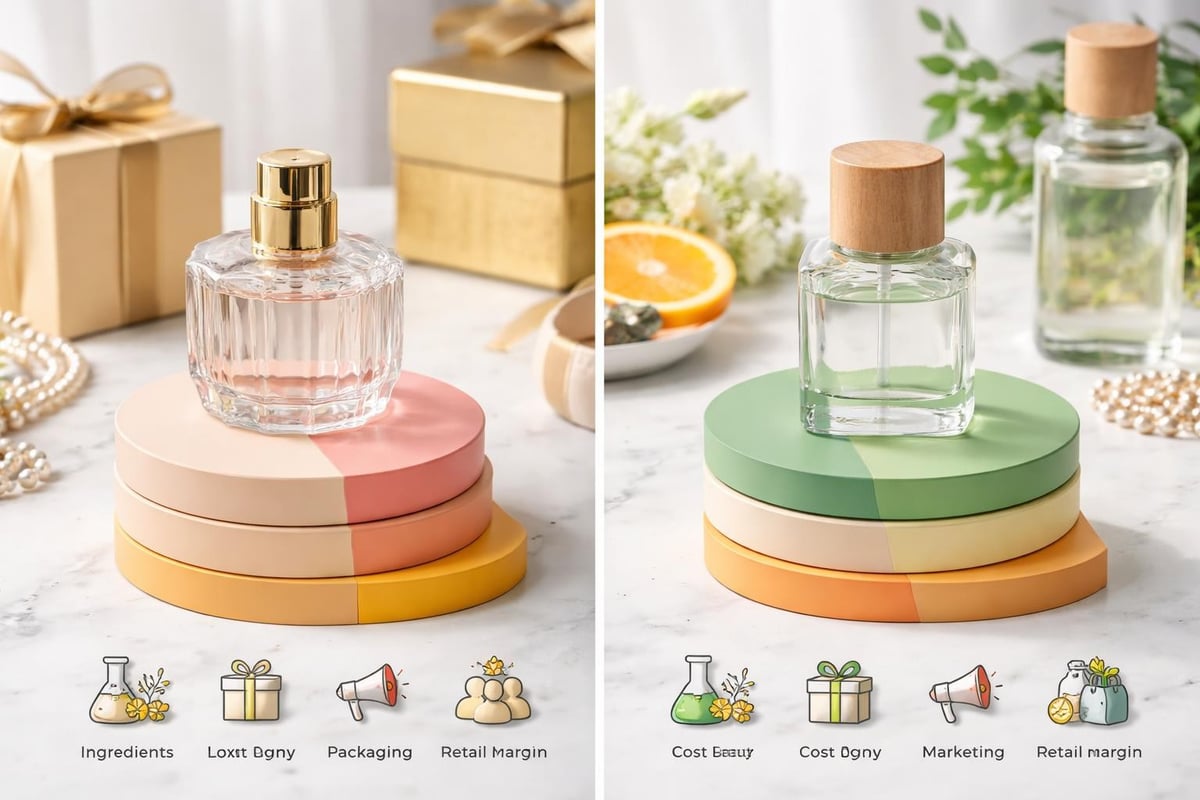
Traditional luxury perfumes often justify high prices through elaborate packaging, exclusive distribution partners, and expensive advertising campaigns. Market analyses show that actual production costs are often below 10% of the sales price.
Clean Beauty brands, in contrast, rely on transparent calculation:
- High-quality raw materials: More budget for better ingredients
- Fair production costs: Appropriate payment in Germany
- Minimalist packaging: Resource-saving and cost-effective
- Direct sales: Elimination of expensive intermediary margins
- Authentic marketing: Community instead of glossy campaigns
This model enables true luxury at fair prices – a promise that is increasingly convincing in the modern perfume market.
Innovation and Product Development
The perfume market benefits from technological advancements in fragrance development. Modern processes enable complex compositions without animal or problematic synthetic substances.
Future-Oriented Ingredients
Natural alternatives to synthetics:
- Biotechnologically obtained fragrances from plant cells
- Upcycling of by-products from the food industry
- Innovative extraction methods for more intense natural aromas
- Molecular design based on plant-based raw materials
Functional additives:
- Skin-caring components for added value beyond the scent
- Long-lasting formulations without questionable fixatives
- Hypoallergenic compositions for sensitive skin
- Moisturizing base ingredients
These innovations show: The perfume market does not have to choose between naturalness and performance. Cutting-edge skincare knowledge is increasingly being incorporated into fragrance development.
Challenges and Opportunities for New Brands
The established perfume market seems dominated by giants. However, precisely this concentration creates space for innovative newcomers.
Success Strategies for Clean Beauty Brands
Authenticity beats budget: While corporations invest millions in advertising, independent brands score with genuine conviction. Consumers recognize the difference between a constructed image and lived values.
Community instead of customers: The modern perfume market is driven by communities. People who share similar values recommend products – more effectively than any paid campaign.
Education as marketing: Sharing comprehensive skin knowledge positions brands as trustworthy experts. Those who understand why certain ingredients should be avoided make more conscious purchasing decisions.
Local production as a USP: Made in Germany in the perfume market means more than just a label. It stands for controllable quality, fair working conditions, and short transport routes.
Regulatory Developments and Standards
The perfume market is increasingly subject to stricter regulations. The EU Cosmetics Regulation sets global standards for safety and transparency.
Important Regulatory Aspects
- INCI declaration: Full ingredient disclosure mandatory
- Allergen labeling: 26 potential allergy triggers must be named
- Animal testing ban: Consistently implemented in the EU since 2013
- Vegan certification: Voluntary standards gaining importance
- Sustainability reporting: Growing pressure for transparency on environmental impact
Developments in the perfumes and deodorants market show that regulation does not hinder innovation but promotes it. Brands that proactively set higher standards gain competitive advantages.
International Perspective and Export Potential
The global perfume market offers German Clean Beauty brands significant growth potential. Especially in North America and Asia, demand for European sustainability standards is increasing.
Regional Market Differences
North America: Clean Beauty already established, high willingness to pay premium prices, strong online retail
Asia-Pacific: Fastest-growing region in the perfume market, rising middle class, increasing environmental awareness
Middle East: Traditionally fragrance-affine culture, preference for intense compositions, growing interest in Western Clean Beauty standards
Latin America: Price-sensitive market, growing urban population, increasing quality awareness
Strategic market insights clarify that German quality standards are perceived internationally as a seal of approval. Berlin as a place of origin further enhances its appeal.
Marketing Strategies for the Modern Perfume Market
Successful marketing in the 2026 perfume market fundamentally differs from traditional approaches. Authenticity, education, and community building replace glamour and aspiration.
Content-Driven Brand Communication
Storytelling with substance:
- Transparent insights into product development and manufacturing
- Personal stories behind the brand and its values
- Educational content on ingredients and skin health
- Honest communication, also about challenges
Influencer collaborations reimagined: The perfume market benefits from authentic brand ambassadors instead of paid testimonials. Micro-influencers with an engaged community often achieve better results than high-reach stars.
User-Generated Content: Real customer experiences are more convincing than perfectly staged campaigns. Brands that actively involve their community create emotional connections and free brand promotion.
Packaging and Presentation
In the perfume market, packaging often determines purchase impulses. But priorities are shifting: from pomp to principles.
Sustainable Packaging Design
| Aspect | Traditional | Clean Beauty |
|---|---|---|
| Material | Heavy glass, plastic | Recycled/Recyclable glass |
| Size | Disproportionately large | Product-optimized |
| Extras | Outer cartons, boxes | Minimal to dispensable |
| Decoration | Elaborate embellishments | Reduced design |
| Refillability | Rare | Increasingly standard |
Minimalist packaging in the modern perfume market communicates value through restraint. Consumers appreciate it when the budget goes into content rather than casing.
Future Outlook and Trends
The perfume market is facing further exciting developments. Several megatrends will shape the coming years.
Personalization Through Technology
AI-powered fragrance recommendations: Algorithms analyze preferences and suggest suitable fragrances – increasingly precise without personal testing.
Custom-blending services: Consumers can create their own compositions from basic modules, which the brand produces individually.
Virtual fragrance experiences: Augmented reality enables first scent impressions before purchase – still in its infancy, but promising.
Wellness Integration
The perfume market is increasingly merging with the wellness industry. Fragrances are understood not only as an aesthetic accessory but as part of holistic self-care.
- Aromatherapeutic effects come into focus
- Fragrances for specific moods and times of day
- Integration into morning and evening routines
- Connection of fragrance and skincare in hybrid products
Transparency as a Competitive Advantage
Brands that voluntarily go beyond standards gain trust. The perfume market increasingly rewards:
- Full supply chain disclosure
- CO2 balances for each product
- Social impacts of raw material sourcing
- Long-term sustainability goals with measurable milestones
- Honest communication about potential for improvement
This development benefits pioneers like Clean Beauty brands, who carry transparency in their DNA from the start.
The perfume market is rapidly evolving towards sustainability, transparency, and conscious consumption. Consumers are increasingly demanding vegan, high-quality fragrances without questionable ingredients – and are willing to pay fair prices for them. If you are among those who do not want to compromise between luxury and values, you will find minimalist unisex perfumes at SOBER BERLIN that are produced in Germany and combine Clean Beauty with sophisticated fragrance. Discover vegan fragrance products that prove that true quality does not require animal suffering or questionable chemicals.